
On this page
Most businesses know they need more growth, but they do not always know which lever matters first.
Some need more qualified traffic.
Some need better conversion.
Some need stronger paid campaigns.
Some need better content.
Some need a cleaner website.
Some need attribution, CRM visibility or a revenue dashboard.
That is why a Digital Growth Plan Generator works well as an interactive lead magnet.
Instead of asking a visitor to download a generic marketing checklist, it asks one simple question: what do you sell, who do you target, what is blocking growth, and what do you want to improve first?
Then it turns that answer into a tailored growth recommendation.
The visitor gets useful strategic direction. The business captures rich intent data.
That is exactly what a strong AI lead magnet should do.
Why this digital growth plan generator works as a lead magnet
A lot of marketing content is useful, but generic.
A blog post can explain SEO. A guide can explain paid ads. A checklist can explain conversion optimization.
But none of those formats understand what the visitor is actually trying to fix.
A digital growth plan generator does.
It gives the visitor space to explain their business in their own words. That open answer can reveal the business model, target audience, current challenge, growth blocker, desired outcome and urgency.
For an agency-style offer, this is extremely valuable.
A visitor might say they want more leads. But inside their answer, they may reveal that organic traffic is weak, paid traffic is expensive, landing pages are underperforming, demo bookings are low, attribution is unclear or their website does not explain the offer well.
That is what makes this magnet powerful.
It does not just capture a lead. It captures the strategy context behind the lead.
Static content explains channels. Interactive tools reveal priorities.
Why a WebFX style example makes sense
WebFX is strongly associated with digital marketing, SEO, paid advertising, CRO, website design, ecommerce growth, revenue tracking and full funnel growth execution.
That makes it a natural reference point for a digital growth plan generator.
A WebFX-style growth plan generator does not need to access real analytics, CRM data or ad accounts to be useful. It can start with a visitor's self-described business problem and generate a directional strategy from that context.
This is especially relevant because digital growth problems are rarely isolated.
- A company may think it needs more traffic, but the real issue may be conversion.
- A company may think it needs paid ads, but the real issue may be the landing page.
- A company may think it needs SEO, but the real issue may be that leads do not turn into pipeline.
- A company may think it needs a redesign, but the real issue may be unclear positioning or weak offer architecture.
That is why this type of generator is useful.
It translates a broad marketing problem into a more focused strategic recommendation. It also helps qualify the lead before a sales conversation.
Why this is more than an AI-coded tool
This WebFX example shows the real power of Magnetly. The tool is not just built with AI. It uses AI live to deliver a personalized strategy to every visitor.
AI app builders are powerful because they help you create software faster. You describe the interface, the logic and the workflow, then the AI helps generate the app.
That is useful, but it is not the same thing as what Magnetly does.
A classic AI-built tool usually has fixed logic. The visitor fills a form, the tool runs predefined rules, then it returns a result.
Magnetly goes further.
Category A
AI app builders
Great for creating software faster.
 Lovable
 Claude
You describe what to build. AI helps generate the app, interface and rules.
Category B
Magnetly
Built for live AI-powered lead magnets.
 Magnetly
Visitors interact with a branded tool. Their answers are sent to AI with your business context, so every result feels tailored.
Lovable and Claude help you build software. Magnetly helps you turn expertise into an AI experience your visitors can use.
With Magnetly, the visitor's answers become live context for an AI system. The tool captures the inputs, combines them with your business knowledge, your final output prompt, optional documents, website context and sometimes external research, then generates a personalized response.
That makes the experience feel less like a static calculator and more like a focused mini AI agent.
This WebFX-style generator is a perfect example.
The visitor only needs to answer one strong open question and provide their website URL. From that, the AI can understand what they sell, who they target, what is blocking growth and what they want to improve first.
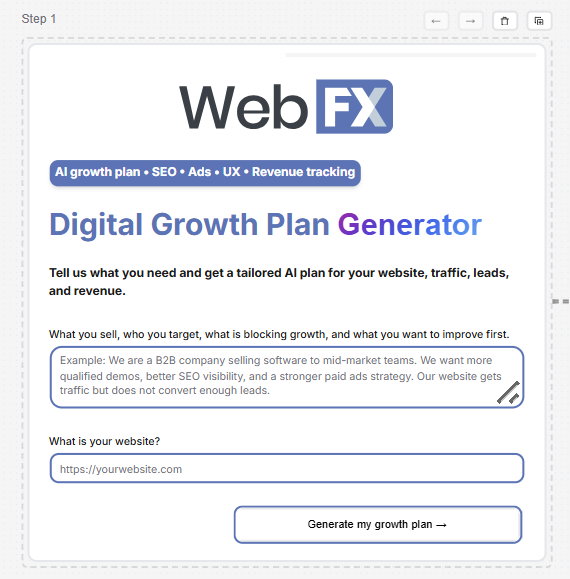
Then the final prompt applies WebFX-style digital growth logic. It maps the visitor's situation to a primary growth priority — SEO, paid media, CRO, UX, revenue tracking, automation or AI search visibility — selects a relevant service stack, explains the strategy and gives a short 30 / 60 / 90 day roadmap.
For an agency, this is extremely valuable.
Instead of building a rigid tool with dozens of branches, the agency can package its expertise inside the prompt. The lead magnet becomes a lightweight AI strategist that works for every visitor, while still capturing rich lead context.
Open answer
The visitor describes their business, target audience, blocker and goal in their own language.
Expert prompt
Your service knowledge, methodology and output rules shape the final recommendation.
Personalized result
The visitor receives a tailored growth plan instead of a generic AI answer.
That is the difference. Magnetly does not just help you build a tool with AI. It helps you turn your expertise into an interactive AI experience that visitors can use.
A coded tool follows logic. A Magnetly tool applies expertise.
The question strategy behind the generator
A strong generator does not need dozens of questions.
Sometimes one well-designed open question can reveal more than a long form. This WebFX-style generator uses a simple structure.
1. Understand the business in the visitor's own words
The open answer asks the visitor to explain what they sell, who they target, what is blocking growth and what they want to improve first.
This is intentionally broad. It gives the visitor room to describe the real problem.
The answer can reveal whether the business is B2B, ecommerce, local services, SaaS, agency, marketplace, creator-led or enterprise. It can also reveal the language they use to describe their pain.
That makes the result more relevant.
2. Capture the website context
The magnet also asks for the website URL.
That matters because a website can provide signals about positioning, offer, market, funnel maturity and conversion path. Even when the website scrape is limited, the URL still gives useful context for the recommendation.
The tool should never claim it analyzed real analytics or live performance data. Instead, it should frame the result as a directional growth plan based on the visitor's answer and available website context.
3. Identify the primary growth category
The final AI prompt classifies the need into a primary growth category. Possible categories include:
- AI and search visibility
- SEO and content growth
- Paid advertising and social ads
- Website and UX redesign
- CRO and conversion improvement
- Revenue attribution and CRM
- Marketing automation and lead nurturing
- Ecommerce or marketplace growth
- AI strategy and integration
- Full service digital marketing plan
This classification is important because it prevents the result from being generic. It forces the recommendation to choose a first priority.
4. Recommend a tailored service stack
The output does not simply say "do marketing." It selects three priority services that match the user's situation.
For example:
- A company struggling with rankings may receive SEO, content marketing and website copywriting.
- A company struggling with paid traffic may receive PPC, social advertising and landing pages.
- A company struggling with unclear ROI may receive revenue tracking, CRM integrations and attribution.
- A company struggling with conversion may receive CRO, website redesign and landing pages.
This turns the lead magnet into a strategic pre-audit.
What the visitor receives
The value of this generator is the personalized growth recommendation.
A weak AI generator gives a generic list of marketing ideas. A strong AI generator turns the visitor's context into a clear plan.
This WebFX Digital Growth Plan Generator is designed to output:
- Hero summary card
- Detected need
- Recommended strategy
- Tailored WebFX-style service stack
- 30 / 60 / 90 day growth roadmap
- Metrics to watch
- Final Magnetly note
The hero summary gives the visitor a clear strategic direction.
The detected need translates the open answer into a business problem.
The recommended strategy explains what to prioritize first.
The service stack shows the three most relevant growth levers.
The roadmap turns the strategy into a staged plan.
The metrics section tells the visitor what to measure.
The final note explains how a real implementation could point to a proposal, service page, strategy call or custom workflow.
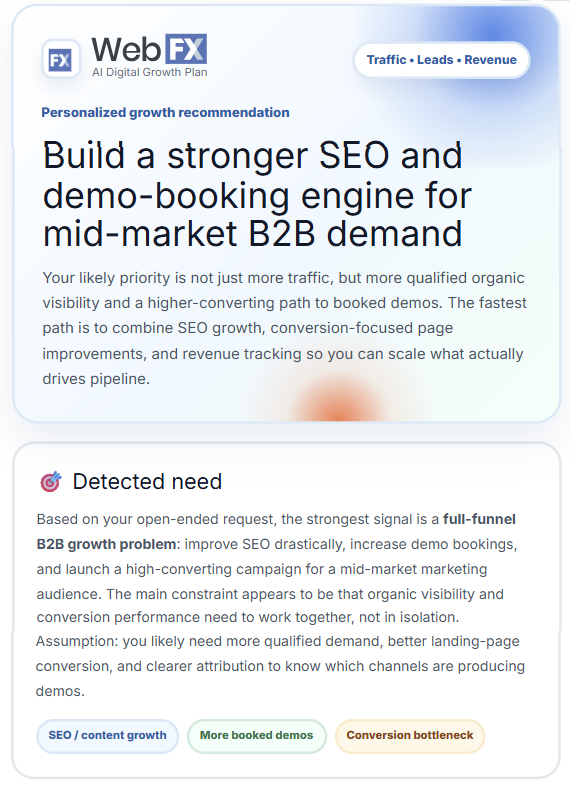
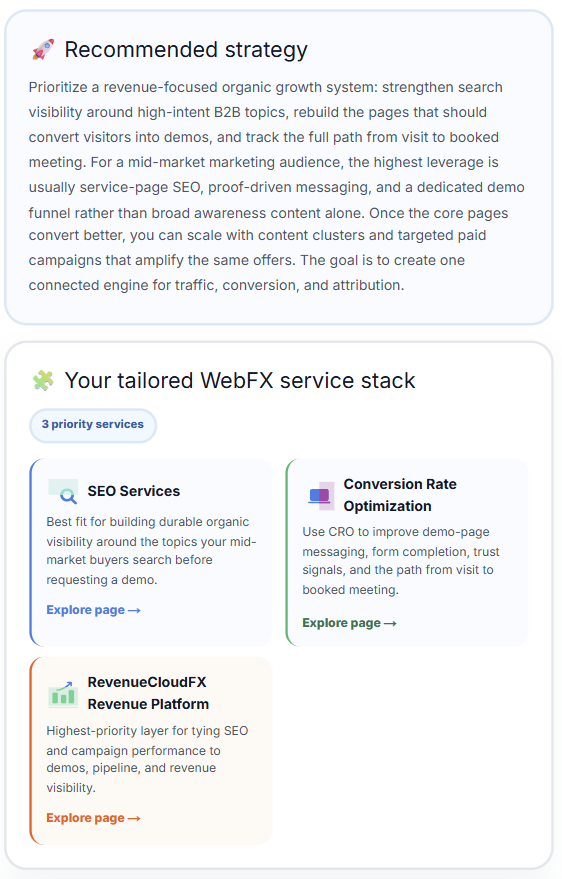
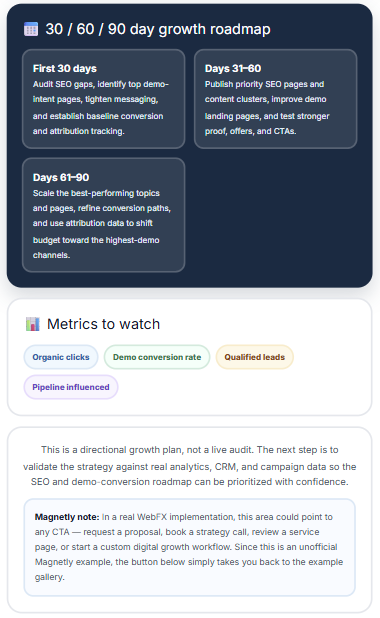
The final output turns a broad growth problem into a structured digital strategy.
The best growth lead magnets do not give visitors more information. They help them choose what to do next.
How to build this type of lead magnet with Magnetly
You can build a digital growth plan generator like this in Magnetly without custom development.
The process is simple.
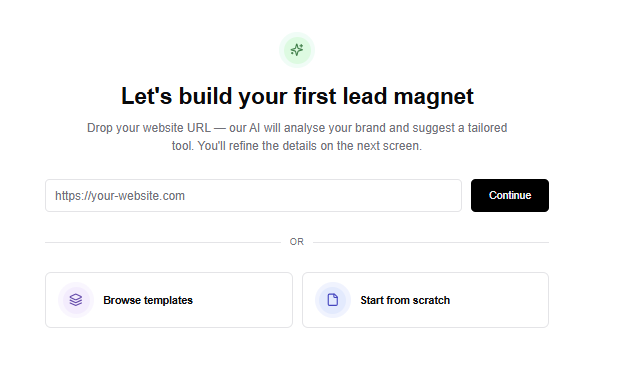
1. Start from a template or URL
You can start from a blank tool, an existing template or a website URL.
For a growth plan generator, the fastest path is usually a simple one-step input flow.
The visitor needs only two things:
- a clear open answer field
- a website URL field
That is enough to generate a meaningful first version.
2. Ask one strong open question
The core question should do a lot of work. For this example, the input asks:
What you sell, who you target, what is blocking growth, and what you want to improve first.
This gives the AI enough context to understand the business problem. It also makes the experience feel lightweight. The visitor does not have to answer ten separate questions before seeing value.
3. Use the website as context
The website URL helps Magnetly create a more grounded recommendation. It can support the AI with page context, positioning signals and business clues.
The final output should be careful not to overclaim. It should not say it analyzed live traffic, CRM data, ad data or rankings. It should say that the recommendation is directional and based on the provided information.
4. Build a polished result
The result should not look like plain AI text. It should look like a strategy dashboard.
For this example, the result includes a summary card, detected need, recommended strategy, service stack, 30 / 60 / 90 roadmap and metrics to watch. That structure makes the output easier to read and more useful for the visitor.
5. Connect the result to a next step
A digital growth plan generator should not end with a generic answer. It should guide the visitor to the next action.
Depending on the business, that CTA could be:
- request a proposal
- book a strategy call
- open a service page
- start a website audit
- download the plan
- launch a custom growth workflow
In this Magnetly example, the native CTA brings visitors back to the example gallery. In a real implementation, the CTA could point anywhere.
Prompt strategy
The final AI output prompt is what turns a simple input into a useful growth recommendation.
For this WebFX-inspired generator, the prompt does four important things.
1. It defines the expert role
The AI is not acting like a generic chatbot.
It is positioned as a senior digital growth strategist, revenue marketing consultant, CRO advisor, SEO strategist, paid media planner, UX consultant and AI marketing strategist.
That role matters because the output needs to balance multiple growth levers.
2. It includes a service knowledge base
The prompt includes a structured WebFX-style service taxonomy. That taxonomy covers:
- SEO and AI search visibility
- paid media
- content marketing
- CRO
- revenue operations
- marketing automation
- commerce platforms
- UX and design
- AI services
- development
- revenue platforms
This allows the AI to recommend a service stack instead of vague marketing advice.
3. It uses decision logic
The prompt does not randomly pick services. It maps the visitor's need to a primary category, then selects exactly three priority services.
For example:
- If the visitor mentions AI search, it prioritizes AI search visibility and ChatGPT optimization.
- If the visitor mentions low conversion, it prioritizes CRO, landing pages and website redesign.
- If the visitor mentions attribution, it prioritizes revenue tracking, CRM integrations and channel attribution.
- If the visitor is broad or unclear, it recommends a digital growth foundation.
This logic makes the output feel guided.
4. It forces a structured result
The output must follow a fixed structure. That is what makes it feel like a polished growth dashboard instead of a loose AI answer.
The structure includes detected need, recommended strategy, tailored service stack, roadmap, metrics and Magnetly note.
This turns the prompt into a repeatable lead magnet engine.
Prompt breakdown
Here is the simplified structure behind the final AI prompt.
Role:
You are a senior digital growth strategist and revenue marketing consultant.

Context:
This is a WebFX-inspired digital growth plan generator created
with Magnetly. It is not an official WebFX tool.

Inputs:
Use the visitor's open answer and website context.

Analysis logic:
Identify the business type, target audience, current issue,
desired outcome and primary growth category.

Service stack logic:
Select exactly three priority services from a WebFX-style
service taxonomy.

Output:
Return a premium growth plan with:

1. Hero summary card
2. Detected need
3. Recommended strategy
4. Tailored service stack
5. 30 / 60 / 90 day roadmap
6. Metrics to watch
7. Magnetly note
This is the part most teams underestimate.
The input captures the business problem. The prompt turns that problem into a structured strategy. That is why the output feels more useful than a generic AI answer.
Where to place this magnet on your website
A digital growth plan generator works best where visitors already know they have a growth problem but do not know what to prioritize.
Your tool
Embed
Share
A digital marketing agency homepage
The generator can turn broad visitor intent into a more qualified growth conversation.
A service page
Place it on SEO, PPC, CRO, web design or growth strategy pages to help visitors self-identify their biggest priority.
A blog article about digital growth
If someone is reading about lead generation, SEO, paid ads or conversion, the generator can turn passive reading into an interactive strategy moment.
A comparison page
Visitors comparing agencies or marketing options can use the generator to understand what kind of help they need first.
A LinkedIn post or newsletter
Because the tool can be shared as a public link, it can also work outside the website.
A resource hub or tools page
The generator can become a permanent free tool that attracts high-intent visitors over time.