
On this page
A lead magnet is not a format.
It is a value exchange.
You give someone something useful, and in return you earn attention, trust, contact information or intent data.
That "something useful" can be many things.
It can be a PDF guide. A checklist. A webinar. A template. A LinkedIn comment that unlocks a resource. A calculator. A quiz. A diagnostic. A free tool embedded directly on your website.
The format matters less than the promise.
A good lead magnet helps the visitor solve a specific problem before you ask them to buy anything.
That is why Magnetly exists.
Instead of helping companies publish another static PDF, Magnetly helps them create interactive AI tools that visitors actually want to use.
This article breaks down one of the most important examples: Magnetly's own Lead Magnet Ideas + Marketing Plan Generator. It helps visitors understand what kind of lead magnet they should create, while showing exactly what Magnetly can do.
The visitor gets value. Magnetly captures qualified demand. Both sides win.
What is a lead magnet?
A lead magnet is any useful asset, experience or offer designed to attract potential customers and encourage them to share information, take action or start a relationship with your business.
The simplest version is a static asset. For example:
- a downloadable PDF
- a checklist
- a template
- a guide
- a webinar
- a swipe file
- a free email course
Those formats can still work. But the internet has changed.
Visitors expect faster value. They do not always want to download another PDF, wait for an email, or read a 30-page guide before they understand what to do next.
That is where interactive lead magnets become stronger.
An interactive lead magnet gives the visitor a personalized result.
Instead of saying:
"Download our guide to learn how to generate leads"
it says:
"Answer a few questions and get the right lead magnet idea for your business"
That difference matters. The visitor gets a result that feels specific. The business captures more context than a basic email form. The experience feels useful before it feels like marketing.
A lead magnet is not just something you give away. It is a value exchange designed to start a qualified relationship.
From static lead magnets to interactive free tools
Inside the lead magnet family, one of the strongest formats is the free tool.
A free tool is not "free" because your software is free. It is free because the visitor can use it without paying.
A free tool can be:
- a calculator
- a simulator
- a quiz
- a diagnostic
- an analyzer
- a generator
- an AI widget
- a recommendation engine
- a scorecard
- a benchmark tool
- a planning tool
The goal is simple. Give the visitor a useful result and capture qualified intent in the process.
That is why free tools can work so well on websites that already have traffic.
A static form asks visitors to give you something before they get value. A free tool gives value first. Then, once the visitor understands the value, it becomes natural to ask for an email, a demo request, a booking or another next step.
This is also why free tools can improve more than lead capture.
- They can increase time on page.
- They can make blog content more useful.
- They can create better internal links.
- They can give people a reason to share the page.
- They can help SEO pages feel less static.
- They can capture structured data about visitor intent.
A good free tool does not replace content. It upgrades content into an experience.
Why this Magnetly lead magnet works
This Lead Magnet Ideas + Marketing Plan Generator works because it matches the visitor's intent perfectly.
When someone lands on Magnetly, they usually have two questions.
First: what does Magnetly actually do?
Second: what kind of lead magnet could work for my business?
This tool answers both questions at once.
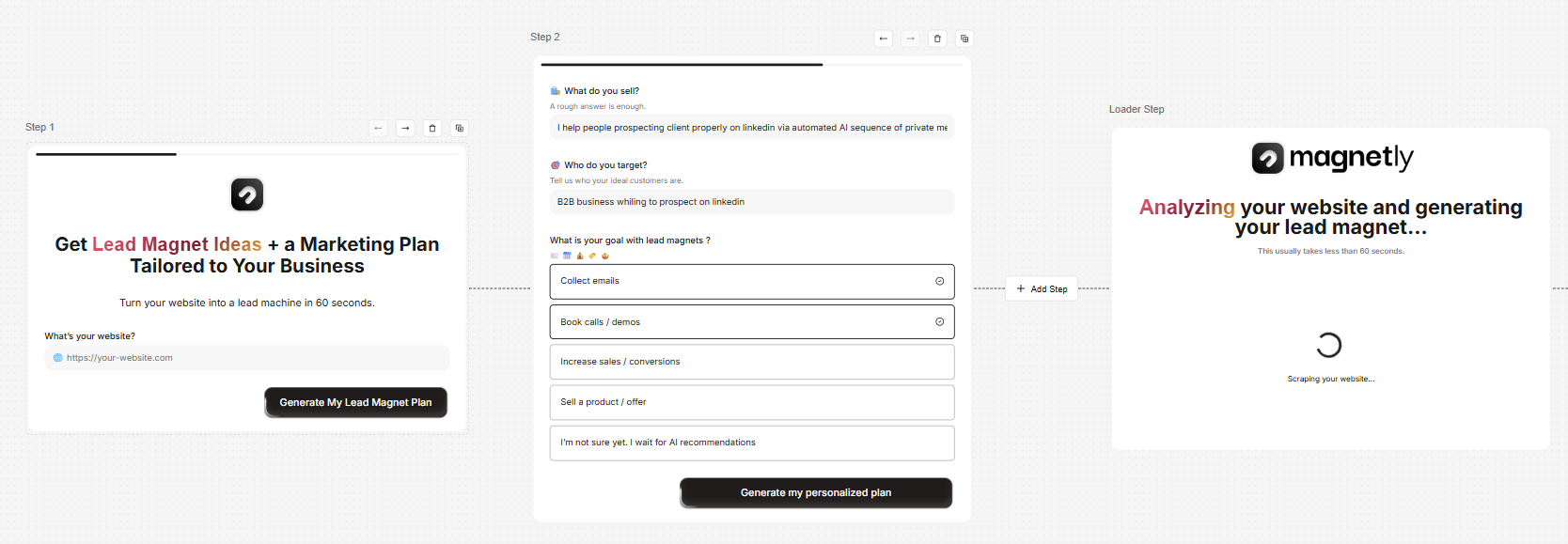
The visitor pastes their website URL. They explain what they sell. They describe who they target. They choose their main goal. Then Magnetly generates lead magnet ideas tailored to that business.
That means the tool is not just a demo. It is a useful strategy experience.
- The visitor learns what they could build.
- They see how Magnetly thinks.
- They understand what kind of output the product can create.
- They give Magnetly valuable qualification data.
That is the perfect lead magnet loop. Value first. Context captured. Product demonstrated. Next step made obvious.
This is the best kind of product-led lead magnet. It teaches the visitor while demonstrating the product.
The proof behind Magnetly's own lead magnet
This example is especially important because Magnetly uses this kind of lead magnet for its own acquisition.
It is not just a theoretical template. It reflects the exact strategy Magnetly recommends to customers.
A visitor comes to the website with curiosity. They may already have traffic. They may already publish content. They may already run ads. They may already have an audience. But they do not know which interactive tool would convert best.
The Lead Magnet Ideas Generator helps them answer that question.
This creates a double effect. First, it captures demand: the visitor shares their website, offer, target audience and lead goal. Second, it creates product understanding: the visitor experiences the value of an AI-powered lead magnet by using one.
Internal Magnetly example
10,000+
daily visits exposed to interactive lead magnet experiences
300–500
leads per month generated from this type of lead magnet
1,000s
of visitor answers collected as ICP and intent signals
Live
product education happening inside the lead magnet itself
Internal Magnetly example. Results vary by traffic quality, offer, page placement and audience intent.
"Magnetly does not only tell visitors that AI lead magnets work. It shows them by letting them use one."
The question strategy behind the generator
A strong lead magnet does not ask random questions. Every question should either improve the visitor's result or help the business qualify the lead.
This Magnetly generator uses a simple but powerful question strategy.
1. Capture the website URL
The website URL gives the AI a real starting point. It helps the tool understand the company, offer, positioning, target market and context.
This matters because lead magnet ideas should not be generic. A B2B SaaS company does not need the same lead magnet as a Shopify brand. A consultant does not need the same lead magnet as a recruitment agency. A creator does not need the same lead magnet as an enterprise software vendor.
2. Understand what the visitor sells
The second layer asks what the business actually sells. A lead magnet should always connect to the offer.
- If the company sells consulting, the tool should generate ideas that reveal pain and create a path to a call.
- If the company sells software, the tool should help visitors diagnose a problem or calculate upside.
- If the company sells ecommerce products, the tool should create quizzes, calculators or recommendation experiences.
- If the company sells services, the tool should create diagnostics that reveal the need for expertise.
The offer shapes the magnet.
3. Understand the target audience
The third layer asks who the business targets. This turns the output from generic to specific.
A lead magnet for founders should not sound like a lead magnet for CMOs. A lead magnet for ecommerce operators should not sound like one for RevOps teams. The target audience changes the pain, language, CTA and result.
4. Understand the goal
The fourth layer asks what the visitor wants from lead magnets.
- Collect emails
- Book calls or demos
- Increase sales or conversions
- Sell a product or offer
- Get AI recommendations
If the goal is email capture, the magnet can be lightweight and high-volume. If the goal is booking calls, the magnet needs stronger qualification. If the goal is selling a product, the magnet should guide purchase intent. That goal shapes the entire strategy.
What the visitor receives
The value of the generator is not the form. The value is the lead magnet strategy it produces.
This Magnetly Lead Magnet Ideas + Marketing Plan Generator is designed to output:
- 3 AI lead magnet ideas
- A recommended idea
- Why each idea fits
- What each idea captures
- What the visitor receives
- SEO keyword suggestions
- Build difficulty
- Quick-win score
- A 7-day acquisition plan
- A relevant benchmark
- A strategy call option
- A CTA to build the magnet in Magnetly
The three ideas give the visitor options. The recommended idea helps them avoid choice overload. The "why it fits" section connects the idea to their offer and audience. The captured data section shows what the business would learn from visitors. The output section shows the value the visitor would receive.
The SEO keyword suggestions help the idea become discoverable. The build difficulty and quick-win score make the idea easier to prioritize. The 7-day plan turns the idea into an execution path. The benchmark section adds proof that interactive tools can outperform static content. The strategy call gives visitors a human next step. The native Magnetly CTA turns the idea into action.
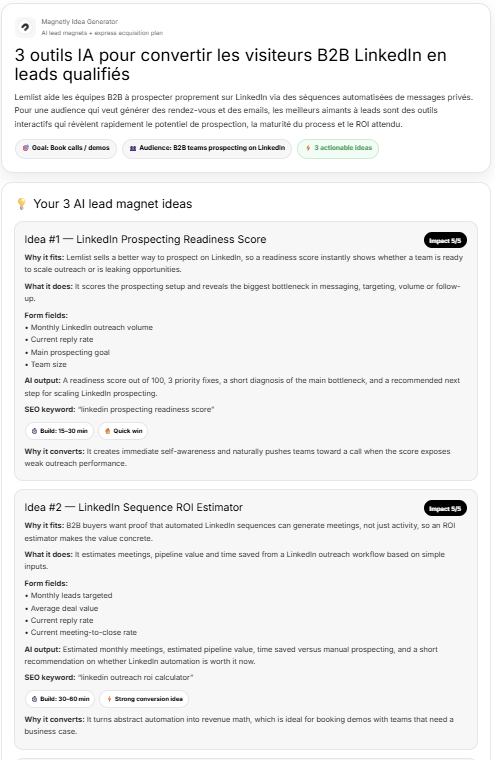
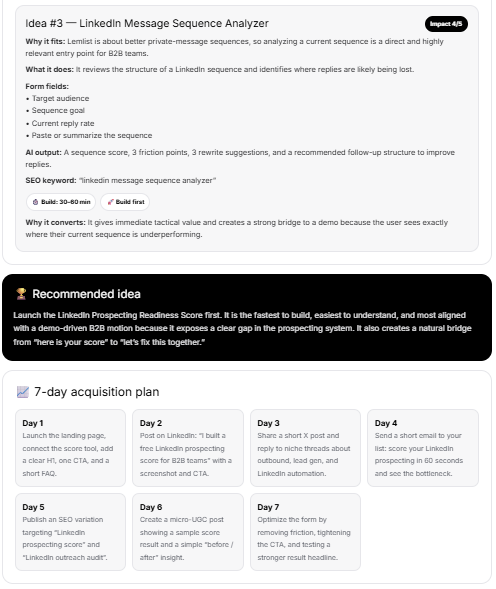
The final output turns a website, offer, audience and goal into actionable lead magnet ideas.
The best lead magnet idea is not the one that sounds clever. It is the one your audience would actually use.
Why free tools can improve conversion, SEO and retention
Free tools are powerful because they change how visitors behave on a page.
A static page can inform. An interactive tool can make the visitor participate. That participation creates several advantages.
- Conversion: a visitor who uses a tool has invested time and received value, so the next step feels natural.
- Lead quality: instead of capturing only an email, the business captures structured answers about offer, audience, goal and intent.
- Retention on SEO pages: a blog article with a useful embedded tool gives visitors a reason to stay, interact and explore.
- Better content: instead of ending a blog post with a generic CTA, the page can offer a tool that matches the topic.
- Sharing: a useful calculator, quiz, diagnostic or generator is easier to share than a generic form.
Vendor benchmarks suggest interactive forms can convert significantly better than static forms (Outgrow reports up to 47.3% vs 2.8%, ~16.9x higher average conversion across 50,000+ interactive forms and 1,200 companies). Use this as directional proof, not a guarantee — every Magnetly tool depends on traffic quality, offer and placement.
Why this is more than an AI-coded tool
This Magnetly example shows the real power of the product. The tool is not just built with AI. It uses AI live to deliver personalized lead magnet strategy to every visitor.
AI app builders are powerful because they help you create software faster. You describe the interface, logic and workflow, then the AI helps generate the app.
That is useful, but it is not the same thing as what Magnetly does.
A classic AI-built tool usually has fixed logic. The visitor fills a form, the tool runs predefined rules, then it returns a result.
Magnetly goes further.
Category A
AI app builders
Great for creating software faster.
 Lovable
 Claude
You describe what to build. AI helps generate the app, interface and rules.
Category B
Magnetly
Built for live AI-powered lead magnets.
 Magnetly
Visitors interact with a branded tool. Their answers are sent to AI with your expertise, so every result feels tailored.
AI app builders help you build software. Magnetly helps you turn expertise into an AI experience your visitors can use.
A coded tool follows logic. A Magnetly tool applies expertise.
How to build this type of lead magnet with Magnetly
You can build a lead magnet idea generator like this in Magnetly without custom development. The process is simple.
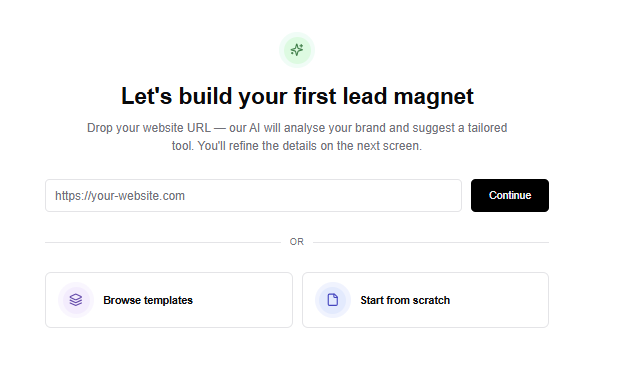
1. Start from your website URL
The easiest starting point is the website URL. Magnetly can use it to understand the brand, offer, positioning and visual identity. This helps the tool feel native to the business instead of generic.
2. Ask the minimum number of strategic questions
The tool does not need a long form. For this example, the strongest inputs are:
- Website URL
- What the business sells
- Who the business targets
- Main goal with lead magnets
That is enough to produce relevant lead magnet ideas. The goal is not to ask everything. The goal is to ask the few questions that make the output useful.
3. Build the flow visually
Inside Magnetly, each step appears as a card in a horizontal builder canvas. You can edit the title, subtitle, input types, options, logic, visual style and buttons. This makes it easy to build a guided experience instead of a static form.
4. Write the final AI output prompt
The final prompt is where the business expertise lives. For this example, the prompt tells the AI how to:
- interpret the website
- understand the offer
- identify the target audience
- choose relevant lead magnet formats
- generate three ideas
- select the strongest idea
- explain what each idea captures
- create a simple acquisition plan
- add a benchmark
- guide the visitor toward the next step
This is what turns the tool into a real strategy experience.
5. Connect the output to action
The final output should not end with information. It should guide the visitor to a next step.
- Build the recommended magnet
- Book a strategy call
- Explore more examples
- Go back to the template gallery
- Start from the website URL
The goal is to make the visitor think: "I can actually launch this."
Prompt strategy
The final AI output prompt is what turns a simple generator into a useful lead magnet strategist. For this Magnetly generator, the prompt should do five important things.
1. It defines a growth strategist role
The AI should not act like a generic idea generator. It should act like a lead magnet strategist who understands acquisition, conversion, SEO, free tools, qualification and product-led growth.
2. It interprets the business context
The prompt should use the website, offer, audience and goal. A good lead magnet is always contextual. The same business can need different lead magnets depending on whether it wants emails, demos, sales, product education or qualification data.
3. It chooses the right lead magnet format
The prompt should think in formats: calculator, quiz, diagnostic, analyzer, simulator, generator, scorecard, benchmark tool, planning tool or recommendation engine. The format should match the visitor's audience and goal.
4. It ranks ideas by usefulness
The prompt should not just list ideas. It should explain which one is most likely to work first. That recommendation should consider:
- audience intent
- ease of build
- conversion potential
- SEO potential
- value delivered
- data captured
- fit with the business goal
5. It turns the idea into an action plan
A strong output should help the visitor act. That is why this generator includes a 7-day acquisition plan. The plan helps the visitor understand how to launch, publish, share and improve the recommended lead magnet. This makes the result feel practical instead of theoretical.
Prompt breakdown
Here is the simplified structure behind the final AI prompt.
Role:
You are a senior lead magnet strategist, AI tool architect
and acquisition consultant.

Context:
This is Magnetly's own Lead Magnet Ideas + Marketing Plan
Generator.

Inputs:
Use the visitor's website URL, offer, target audience and
main lead magnet goal.

Analysis logic:
Understand the business, audience, offer, traffic opportunity
and conversion objective.

Idea generation logic:
Generate three interactive lead magnet ideas that could be
built with Magnetly.

Recommendation logic:
Select the strongest idea based on value, conversion
potential, speed to launch and data captured.

Output:
Return a premium strategy result with:

1. Hero summary card
2. Three AI lead magnet ideas
3. Recommended idea
4. 7-day acquisition plan
5. Relevant benchmark
6. Strategy call option
7. Magnetly CTA
This is the part most teams underestimate.
The questions collect the business context. The prompt turns that context into a practical acquisition asset. That is why the output feels more useful than a generic list of lead magnet ideas.
Where to place this magnet on your website
A lead magnet idea generator works best where visitors already understand they need more leads but do not yet know what to build.
Your Magnetly tool
A homepage
This is ideal for Magnetly because the tool immediately explains the product and gives the visitor a reason to interact.
A blog article about lead magnets
If someone is reading about lead magnet ideas, free tools or website conversion, the generator turns educational intent into an interactive strategy experience.
A pricing or product page
The tool can help visitors understand the business value before they decide whether Magnetly is right for them.
A template gallery
Instead of showing examples only, the generator can recommend which template fits the visitor's business.
A LinkedIn post or newsletter
Because the tool can be shared as a public link, it can also work outside the website.
A resource hub or tools page
The generator can become a permanent free tool that attracts high-intent visitors over time.